
Frequently Asked Questions
Investors considering opportunities for capital appreciation and income generation may wish to consider adding equity-linked notes (ELNs) to their portfolios.
By providing regular coupon payments and offering flexibility relating to the underlying shares, we believe ELNs can be attractive to a range of investors.
Learn more about the potential opportunities and risks involved with investing in ELNs.
An equity-linked note (ELN) is a structured investment product that pays a coupon similar to a bond, but whose return is also tied to the performance of an underlying equity investment. An ELN has a cap that limits the upside return of the underlying security to a predetermined amount. (The cap, the coupon and the duration of the ELN are negotiated with the issuing bank and determined at the inception of the note.) This idea is similar to a covered call strategy, in which an investor takes a long position in a security but seeks to create income by selling a call option (an option with the right to buy a security at a specific price and time frame) that limits the upside capital appreciation potential of the underlying security. However, unlike an option, an ELN cannot be terminated by the issuer. Therefore, although the upside potential may be limited by the cap, the ELN can provide its owner the benefit of attractive coupon payments.
ELNs issued in the US are customized structured notes generally written under the Securities and Exchange Commission’s US medium-term note program. They are not derivatives, but are considered senior unsecured debt. They are issued by major investment banks and are traded over-the-counter (OTC). Due to the short-term nature of the notes (generally three to 12 months) they are not rated. This results in some savings for the investor, who avoids expenses that would otherwise be incurred in the ratings process.
Example of an equity-linked note
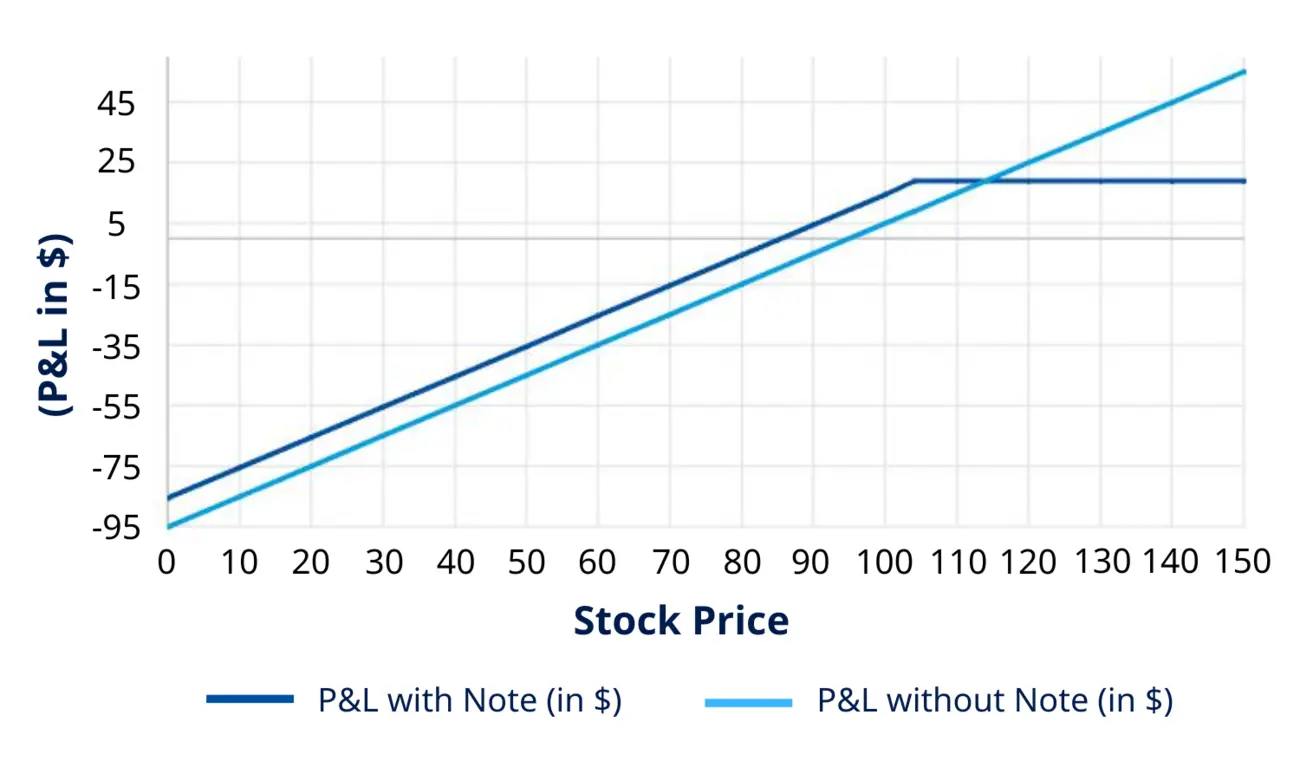
The example below depicts the fictional stock of XYZ Company, which, at the initiation of the note, has a purchase price of $95. If an ELN is written with a 110% cap, the upside limit on appreciation would be capped at $104.5. The investor will also collect a 10% coupon during the period determined at contract initiation (in this example, the period is 53 weeks.) The note retains the full downside risk associated with the underlying equity.
53-week duration, $95 purchase price, 110% cap and a 10% coupon
What are the potential benefits of equity-linked notes in a portfolio?
We believe ELNs can help investors pursue attractive income as well as capital appreciation potential. Other potential benefits can include:
An effective way to help diversify1 a portfolio within a well-diversified portfolio of global stocks.
The potential for custom maturity dates outside of listed calendar expiration dates.
The note contract ensures coupon/units do not change during the life of the note, even if dividend is cut.
The potential for reduced interest rate risk (due to short durations) usually associated with higher-yielding securities.
What are the risks of equity-linked notes?
There are two primary risks associated with ELNs: (1) The default risk of the issuing bank; (2) The full downside risk associated with the underlying security. While these risks cannot be completely avoided, they can be reduced. The risk of one issuer defaulting can be reduced by having a portfolio of notes issued by a diversified1 group of banks, especially those with higher credit ratings. Investors can also use tools such as equity futures to hedge the associated equity risk and help mitigate the risk of market losses.
How are equity-linked notes structured?
Selecting the underlying security is an important part of the process; investment managers can either structure notes on a basket of securities or on individual securities. Ideally, the investment manager will create notes based on equities of companies with strong fundamentals such as attractive valuations, low variation of earnings, high returns on invested capital and higher yield potential.
The process of negotiating the ELN involves seeking quotes for annualized coupons from each counterparty through a blind auction. The investment manager generally selects the broker that offers the most attractive yield potential for the chosen duration, which is usually 53 weeks.
How do investment managers seek to reduce risk?
Due to the downside risk and the return cap, investment managers may choose to avoid stocks with high price volatility. In an effort to reduce the downside risk of the underlying security, investment managers aim to select stocks they believe represent attractive values through rigorous research across industry sectors. From an overall risk perspective, investors can also utilize tools such as selling index futures to hedge the equity risk associated with the chosen positions.
1Diversification does not assure a profit or protect against a loss.
Discover more

Investment Talks - Securitized Credit

Amundi Funds Income Opportunities
This document is issued by Amundi Singapore Limited (Company Registration No. 198900774E) who is regulated by the Monetary Authority of Singapore. This document is for information purposes only, is not a recommendation, financial analysis or an investment advice and does not constitute a solicitation, invitation or offer to purchase or sell any product. The information contained in this document is intended for general circulation without taking into account the specific investment objectives, financial situation or particular needs of any particular person. The information contained in this document is as at 21 August 2026 except where otherwise stated. The information contained in this document has been obtained from sources believed to be reliable but has not been independently verified, although Amundi and its affiliated companies (collectively “Amundi”) believe it to be fair and not misleading. Opinions expressed in this document are subject to change without notice. Amundi does not accept liability whatsoever whether direct or indirect that may arise from the use of information contained in this document. Amundi and its associates, directors, connected parties and/or employees may from time to time have interests and/or underwriting commitments in the securities mentioned in this document. Past performance and any forecasts made are not necessarily indicative of the future results. Any forecast, projection or target is indicative only and is not guaranteed in any way. All investments involve risks and the amount received from such investments may be less than the original invested amount. Amundi does not guarantee that all risks associated with the securities mentioned herein have been identified, nor does it provide advice as to whether you should enter into any transaction. This document is solely for issue in permitted jurisdictions and to persons who may receive it without breaching applicable legal or regulatory requirements. The information contained in this document shall not, without prior written approval of Amundi Singapore Limited, be copied, reproduced, modified, or distributed, to any third person or entity in any country. This document is not for distribution and does not constitute an offer to sell or the solicitation of any offer to buy any securities or services in the United States or in any of its territories or possessions subject to its jurisdiction to or for the benefit of any U.S. Person (as this term is defined in SEC Regulation S under the U.S. Securities Act of 1933).
Amundi Singapore Limited Company Registration No.: 198900774E This advertisement or publication has not been reviewed by the Monetary Authority of Singapore