
This document contains information about Amundi Funds Income Opportunities (the “Fund”), a sub-fund of Amundi Funds, an undertaking for collective investment in transferable securities existing under Part I of the Luxembourg law of 17 December 2010, organised as a société anonyme and qualifying as a société d’investissement à capital variable and registered with the Luxembourg Trade and Companies Register under number B 68.806 and having its registered office at 5, allée Scheffer, L-2520 Luxembourg. The management company of the Fund is Amundi Luxembourg S.A., 5, allée Scheffer, L-2520 Luxembourg and the Singapore Representative of the Fund is Amundi Singapore Limited (Registration No. 198900774E), 80 Raffles Place, UOB Plaza 1, #37-01A, Singapore 048624 (Amundi Luxembourg S.A. and/or its affiliated companies, including without limitation Amundi Singapore Limited, being hereinafter referred to individually or jointly as "Amundi”). Amundi Singapore Limited is regulated by the Monetary Authority of Singapore. This is a marketing communication. Investors should read the Singapore Prospectus and the Product Highlights Sheet before deciding to invest in the Fund. The share classes / classes of the Fund available for offer to the retail public in Singapore are set out in the Singapore Prospectus and the Product Highlights Sheet, which together with the latest annual and semi-annual reports (if any) may be obtained, free of charge, at the registered office of the Singapore Representative of the Fund or at www.amundi.com.sg or the Fund’s authorised distributors. This document is for information purposes only, is not a recommendation, financial analysis or advice, and does not constitute a solicitation, invitation or offer to purchase or sell the Fund in any jurisdiction where such offer, solicitation or invitation would be unlawful. This information is not for distribution and does not constitute an offer to sell or the solicitation of any offer to buy any securities or services in the United States or in any of its territories or possessions subject to its jurisdiction to or for the benefit of any U.S. Person (as this term is defined in SEC Regulation S under the U.S. Securities Act of 1933 and in the Singapore Prospectus of the Fund). The Fund is not registered in the United States under the Investment Company Act of 1940 and shares / units of the Fund are not registered in the United States under the Securities Act of 1933. Accordingly, this document is for distribution or to be used solely in jurisdictions where it is permitted and to persons who may receive it without breaching applicable legal or regulatory requirements, or that would require the registration of Amundi or its affiliates in these countries. Past performance and any forecasts made are not indicative of future performance of the Fund. Please note that distribution/dividends (if applicable) are not guaranteed unless otherwise stated in the dividend policy for the relevant share class / class contained in the Singapore Prospectus. Investors should review the relevant dividends disclosure report (if applicable) found on www.amundi.com.sg. Any opinion or view presented is subject to change without notice. The information in this document is intended for general circulation without taking into account the specific investment objectives, financial situation or particular needs of any particular investor. An investor may wish to seek advice from a financial adviser regarding the suitability of the Fund, taking into account the specific investment objectives, financial situation or particular needs of any person in receipt of the recommendation, before making a commitment to purchase shares / units in the Fund. The Fund may invest in Additional Tier 1 and/or Tier 2 capital instruments issued by banks and insurers incorporated in Singapore, which have loss absorption features and include terms which may result in such instruments being, inter alia, partly or wholly written off, written down and/or converted to ordinary shares of the issuer upon the occurrence of a pre-defined trigger event. Trigger events are complex and difficult to predict, may be outside of the issuer’s control (for example, due to regulatory action) and can result in a significant or total reduction in the value of such instruments, thereby giving rise to loss suffered by the Fund. Investors should not purchase the shares / units of the Fund if they do not understand the nature of an investment in Additional Tier 1 and/or Tier 2 capital instruments or are not comfortable with the accompanying risks. Retail investors who do not have the knowledge or experience of investing in such sophisticated products are encouraged to seek advice from a professional financial adviser. Investors should determine the suitability of an investment in the Fund in light of their own circumstances, and in particular the risk that their lack of relevant knowledge and expertise may cause them to lose all or a significant portion of the amount invested. Where applicable and contemplated in the Singapore Prospectus, the Fund may invest in financial derivatives as part of its strategy, and a material portion of the returns may be generated from financial derivative strategies. In such scenarios, the Fund will be subject to risks associated with such investments as further detailed in the Singapore Prospectus. Additional risk factors are described in the Singapore Prospectus. Investments in the Fund are subject to investment risks, including the possible loss of the principal amount invested. Such activities may not be suitable for everyone. Value of the shares / units in the Fund and the income accruing to the shares / units, if any, may fall or rise. Any forecast, projection or target is indicative only and is not guaranteed in any way. Such information is solely indicative and may be subject to modification from time to time. It is the responsibility of investors to read the legal documents in force in particular the current Singapore Prospectus of the Fund. Subscriptions in the Fund will only be accepted on the basis of their latest prospectus available in English and/or the Product Highlights Sheet. A summary of information about investors’ rights and collective redress mechanisms and sustainability-related aspects (if applicable) can be found in English on the regulatory page at https://about.amundi.com/Metanav-Footer/Footer/Quick-Links/Legal-docume…. The information contained in this document is as at 22 July 2026 except where otherwise stated. The information contained in this document has been obtained from sources believed to be reliable but has not been independently verified, although Amundi and its affiliated companies believe it to be fair and not misleading. Amundi does not accept any liability whatsoever whether direct or indirect that may arise from the use of information contained in this document. Amundi and its associates, directors, connected parties and/or employees may from time to time have interests and/or underwriting commitments in the investments mentioned in this document. Amundi does not guarantee that all risks associated with the transactions mentioned herein have been identified, nor does it provide advice as to whether you should enter into any such transaction. Amundi does not make any representation as to the merits, suitability, expected success, or profitability of any such transaction mentioned herein. Pursuant to the new Guidelines on marketing communications under Regulation (EU) 2019/1156 of 20 June 2019 on cross-border distribution of funds issued by the European Securities and Markets Authority (ESMA), performance returns which are less than 12 months will not be reported for European domiciled funds. This advertisement or publication has not been reviewed by the Monetary Authority of Singapore. The information contained shall not be copied, reproduced, modified, translated or distributed without the prior written approval of Amundi. Date of publication: 22 July 2026
Global markets remain highly uncertain. Elevated geopolitical risks, volatile interest-rate expectations and persistent macroeconomic headwinds are prompting investors to look for resilient, adaptable strategies. In today’s environment of heightened volatility and unpredictable market swings, relying on a single asset class is no longer sufficient in navigating changing market conditions. For investors seeking to navigate market turbulence while both preserving and growing wealth over the long term, flexibility and active management have become essential.
Rate-Cut Expectations and Elevated Valuations: A Double Squeeze
Investors are currently caught between two opposing forces. On one hand, the appeal of traditional fixed income has weakened as markets increasingly price in interest rate cuts. On the other, valuations across many asset classes remain stretched, particularly in high-risk areas such as mega-cap technology stocks, where upside may be limited and volatility remains elevated.
Moreover, with market performance heavily concentrated in a narrow set of assets, portfolios are more vulnerable to sudden shocks such as persistent inflation or slowdowns in consumer spending. In this environment, one of the biggest challenges for investors is how to generate stable returns while balancing risk and reward.
Strategy 1: Diversification Through Multi-Asset Allocation
In volatile markets, diversification is an essential principle that cannot be overlooked. True multi-asset allocation should not be confined to simple equity-bond portfolios, but should encompass a broad range of geographies, asset types, and characteristics.
By allocating capital across equities, a broad range of bonds and alternative investments, investors can reduce the impact of any single market swing on their portfolio. This approach is designed to take advantage of the low correlation between asset classes, providing a cushion during periods of uncertainty and helping to reduce concentration risk.
Strategy 2: Prioritising Quality Assets
As economic growth slows, markets often shift their focus toward resilience and reliability. High-quality assets typically provide stronger downside protection and more stable cash flows. In equities, this means looking for companies with solid fundamentals and valuations. In fixed income, the emphasis should be on bonds with higher credit quality, such as investment-grade securities.
A flexible strategy built around quality can help preserve portfolio value even when market sentiment turns cautious, while also positioning investors to benefit when the economy begins to recover.
Strategy 3: Adopting an Income-Driven Approach
In an environment where capital appreciation potential is slowing, income becomes a key driver of total return. By actively allocating to instruments that provide stable dividend or coupon income, investors can create a defensive layer within their portfolio.
Beyond traditional equity dividends and bond coupons, incorporating alternative income sources such as Equity Linked Notes (ELNs) or securitized assets into a portfolio can further enhance its overall income potential.
A Professional Solution for Multiple Needs
For many investors, achieving diversification, selecting high-quality assets and generating consistent income at the same time can be too challenging and time-consuming, as it requires constant monitoring of market conditions and a high level of investment expertise.
In contrast, professionally managed multi-asset funds offer a more efficient and cost-effective solution. Fund managers actively adjust asset allocations dynamically across market cycles and use hedging instruments to manage downside risk, helping investors navigate complex and volatile markets while progressing toward their investment goals.
Take Amundi Funds Income Opportunities as an example. As it is not constrained by a benchmark, the fund can actively capture investment opportunities around the world. Its investment universe is exceptionally broad, spanning U.S. and developed-market equities, Agency Mortgage-Backed Securities (Agency MBS), and even emerging market assets.
The fund's management team has demonstrated a strong ability to adapt to changing conditions. In 2025, for example, it reduced exposure to high-yield bonds as credit spreads tightened, and instead increased allocations to Agency MBS, where spreads were more compelling, as well as to ELNs, which can offer income alongside a capped growth potential. This exemplifies a truly dynamic approach to asset allocation.
Income remains at the core of the fund’s strategy, which combines both traditional and alternative sources of income. In addition to high-quality dividend-paying stocks and bonds, the fund strategically leverages ELNs as a supplementary income source. In particular, when credit spreads are tighter, ELNs can offer a stronger income profile than traditional bonds.
As of the first quarter of 2026, the fund’s portfolio yield reached 7.2%, outperforming investment-grade bonds (5.2%) and global equities (1.7%), providing investors with sustained and competitive cash flow support.
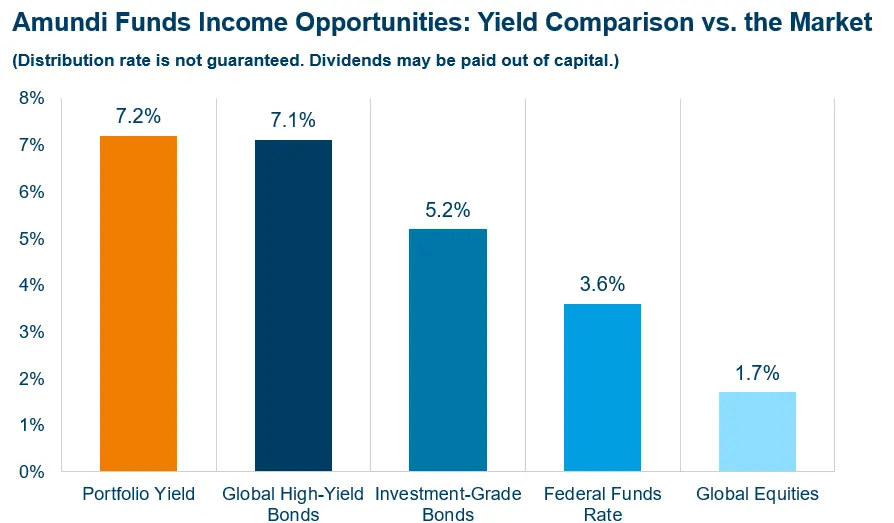
Source: Amundi, as of 31 March 2026, based on the ICE BofA Global High Yield Index (Global High-Yield Bonds), the ICE BofA US Corporate Bond Index (Investment-Grade Bonds), and the MSCI All Country World Index (Global Equities). Past performance is not indicative of future returns. For illustrative purposes only.